



Selective Laser Sintering, we explain everything!
12/25/2017
There are several 3D printing technologies in the industry, used mainly in different sectors and for various applications. Among them is selective laser sintering, better known by its English acronym SLS (Selective Laser Sinteting). How does this technology work? What materials can be used? We explain everything!
The development of selective laser sintering or SLS technologies began in the 1980s: it was Dr Carl Deckard and Joe Beaman from the University of Texas at Austin in the United States who developed the foundations of powder fusion technology. They are compatible with a multitude of materials, from polymers to metals, thanks to the use of a laser. When we talk about SLS technology, we mainly find plastic polymers and primarily nylon.
The development of this powder sintering technology was patented by DTM Corporation, acquired in 2001 by 3D Systems. Other companies quickly specialised in this manufacturing process, notably the Chinese company Farsoon Technologies in 2009. Note also that a process similar to SLS had been invented and patented in 1979 by R.F Housholder but was never commercialised.
How does selective laser sintering or SLS work?
Selective laser sintering makes it possible to print functional objects without using an intermediate binder or a possible assembly step. Before printing, the object is designed using CAD software (CATIA, SolidWorks, ProEngineer for example) to be sent to the printer in digital format. Then, printing is done layer by layer, from sintered powders, thanks to the temperature generated by a CO2 laser.

To start the process and prepare the SLS 3D printer, the powder bed and the print platform are first heated below the melting temperature of the polymer. The first layer of powder is then deposited on the platform (2). It is swept by the laser beam which causes the sintering and then the consolidation of the powder (3). When the layer is finished, the platform lowers and is covered with a new layer of material. The steps are repeated until the solid 3D part identical to the original CAD file is obtained (4).
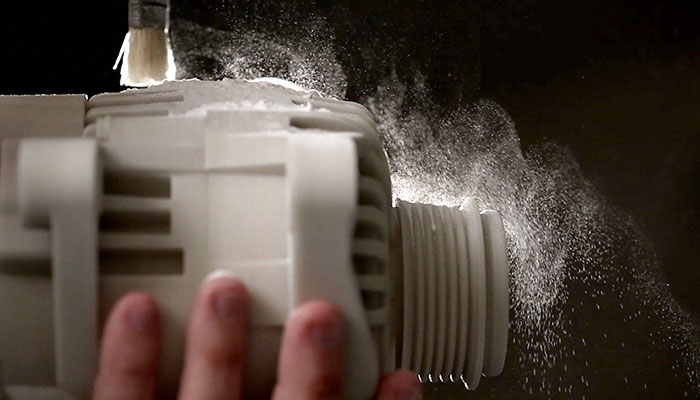
After printing, the parts are completely enveloped in powder. This powder bin must be cooled before it can be cleaned and post-processed. This can take up to 12 hours. Afterwards, the parts are cleaned with compressed air or another cleaning method and are ready to be used.

Materials for selective laser sintering
Powder sintering technologies make it possible to manufacture objects in a wide range of materials, although, when we talk about the SLS technique, we are talking about plastic polymers. The most common is polyamide (PA 12), better known as Nylon 12. It is also compatible with polypropylene, alumide, carbonmide, PEBA, PA11 and PEEK. It is also possible to add fibres to materials such as carbon, glass or aluminium fibres, thus improving the mechanical behaviour of the parts.

Most initial uses of this technology were related to prototype development, but as materials become increasingly stronger and SLS 3D printer prices have become cheaper, there is a trend towards the production of final parts.
Players and Developments
SLS technology is used in several fields, from design to the automotive industry, including aerospace, engineering, etc. Just a few years ago, the main manufacturers of selective laser sintering 3D printers were 3D Systems and EOS GmbH, mainly specialised in the professional sector. The latter manufacturer is the only one to have developed SLS machines capable of printing with high-performance thermoplastics such as PEEK. In 2014, the patent for this technology expired, which allowed many players to stand out, such as Natural Robotics and its VIT machine or Formlabs and its new Fuse 1. It is thus possible to democratise these technologies and bring them closer to a larger number of users.

In the following video, the Xometry team explains in detail a little more about SLS technology:
And you, do you use selective laser sintering technology? Share your opinion in the comments of the article.