




NIST could improve the adoption of large-scale metal 3D printing
03/21/2020
One of the biggest obstacles to the widespread adoption of metal 3D printing is that there are still major gaps in understanding what happens to the material during the process. Specifically, there are few tools that can show what happens to the internal structure of different metals when they are melted and then solidified during printing. However, this problem could be a thing of the past. The National Institute of Standards and Technology (NIST), the KTH Royal Institute of Technology in Sweden and other institutions have announced a breakthrough in the ability to predict and control the characteristics of 3D printed metal parts. This could make the adoption of metal 3D printing easier for large-scale manufacturing.
This is not the first time NIST has taken an interest in metal 3D printing. Last year, shortly after the Biden administration launched the AM Forward initiative, the institution awarded about $3.7 million in grants to overcome current and future obstacles to the adoption of metal additive manufacturing. These projects focused on topics such as determining the properties of key materials for quality control in the sector.
Looking to the past to improve metal 3D printing in the future
The news follows another announcement from NASA that it would further study ways to improve the certification and qualification of 3D printed metal parts. 3D printing is only gaining in popularity thanks to its advantages in terms of reducing costs and waste. However, issues related to qualification and consistent properties of parts have made even broader adoption difficult. NIST hopes this discovery could change that, as it will grant what they consider an unprecedented level of control over metal 3D printing. And to do so, they turned to the past.
Scientists knew that to guarantee material properties, a better understanding was needed of what happened during the melting and cooling rates of metal in the printing process. Specifically, they needed to understand how metal cooling rates influence the structure of the part. However, this proved difficult to do because solidification occurs almost instantly, making investigation almost impossible. To work around this problem, researchers used two different particle accelerators to observe the internal structure of steel as it melted and then solidified during 3D printing. X-rays were thus generated by the particle accelerators at Argonne National Laboratory and the Paul Scherrer Institute. They were powerful enough to capture images of the processes, testing temperature rates ranging from tens of thousands to more than a million kelvins per second.
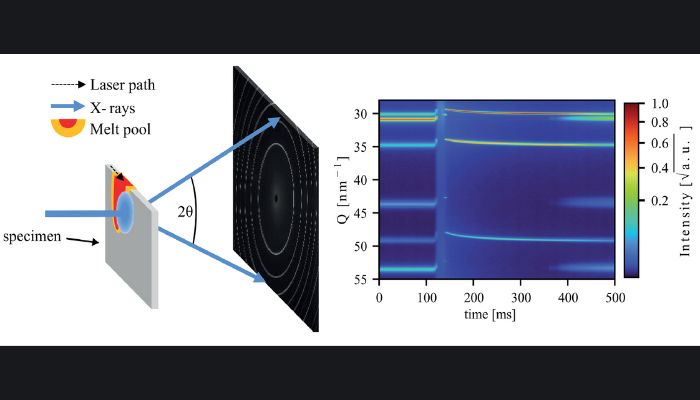
These results were then compared to a computer model developed in the 80s that describes the solidification of alloys. This return to the past was not done without reason. This model is known for predicting material properties in traditional manufacturing processes, but until now, it was not certain whether it was applicable to metal additive manufacturing given the rapid temperature changes during printing. The researchers then discovered that what they had observed was also predicted in the model. The computer model has been a reliable tool for material design in traditional manufacturing and it now seems it could be used for 3D printing. The press release mentions that the model could be used to inform scientists and engineers about the cooling rates needed for the first stages of solidification in the printing process. This will ensure that the optimal structure appears in the desired material, making metal 3D printing more reliable overall.
NIST physicist Fan Zhang, co-author of the study, concluded:“Basically, if we can control the microstructure during the early stages of the printing process, we can then obtain the desired crystals and, ultimately, determine the performance of additively manufactured parts. The model and the experimental data are in good agreement. When we saw the results, we were really excited. If we have data, we can use it to validate models. That is how you accelerate the widespread adoption of additive manufacturing for industrial use.You can learn more in the research paper published in Acta MaterialiaICI.
What do you think of this NIST research? Do you think metal additive manufacturing will be even more widely adopted by industry? Share your opinion in the comments of the article.
*Cover photo credits: CCDC Army Research Laboratory